Mauritania finds itself caught between inherited social strata that assign individuals their place from birth, tutelary tribes that enclose them in bonds of blood and loyalty, and distorted religious discourses that sanctify privilege while eroding equality. The country is undergoing a difficult labor: that of the citizen-state, still shackled by the heavy sediments of a tenacious past.
As in much of Africa, the Arab world, and Asia, the march toward modernity is not measured in kilometers alone. It must traverse symbolic distances more formidable than geographical frontiers: those that separate a hesitant present from a past clinging to its pre-state structures. The persistence of the old renders the bond between the state and its citizens fragile, precarious, and often chaotic.
The Burden of Ancient Hierarchies and the Rise of New Stratifications
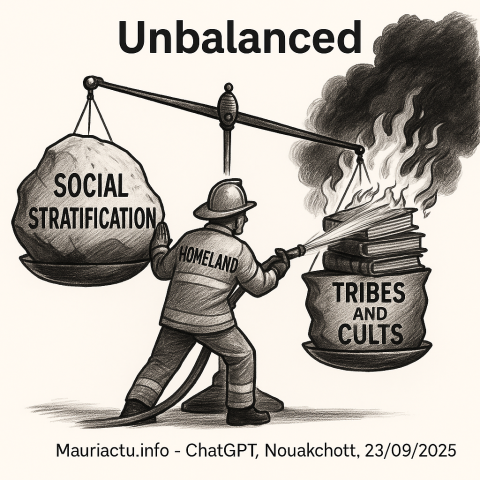
At the heart of Mauritanian society, under the intertwined shadows of tribe, caste, and instrumentalized religion, traditional stratification endures like a rock weighing heavily on the chest of time.
Among the Moors (Bidân), divisions remain stark: Ḥassân (warriors), Zawâya (clerics), Ma’almine (blacksmiths), Ḥarâṭîn (former slaves). In the Black African communities, similar structures persist: Laawɓe (nobles), Toorooɓɓe (clerics), Wayluɓe (artisans), Maccuɓe (captives and former captives). Within these closed universes, position is not earned by merit but transmitted by blood, reinforced by customs and rituals. To defy these codes is to challenge the established order, at the risk of social banishment.
Yet alongside these ancient legacies, new forms of stratification have emerged with the modern state and urbanization. Rooted in professional, cultural, political, or communal identities, they manifest through parties, ideological movements (Islamist, environmentalist, nationalist, anti-slavery, etc.), and various civil initiatives.
This phenomenon is not unique to Mauritania; it is observable everywhere, with varying intensity depending on societal maturity and political leadership. But here as elsewhere, the modern often replicates the ancient: clientelism, opportunistic networks, and factional loyalties prevail. Competence is relegated to the background, eclipsed by allegiance and belonging to exclusive circles.
A Case in Point: The Dual Role of a Political Operator
Some figures epitomize the entanglement of tribalism and modern stratifications. Biram Dah Abeid, both politician and activist, embodies this duality: celebrated as a “prominent political leader” and a “champion of human rights.” A dual stature, enviable in theory, if it were rooted in genuine respect for others and a sincere recognition of difference.
His path, however, remains marked by ambivalence. An unsuccessful candidate in four presidential elections, his trajectory oscillates between fiery denunciations of the Bidân tribal-feudal order and a gradual accommodation with the very legacy he once sought to dismantle. This paradox speaks less to selflessness than to opportunism, aimed at expanding his electoral base.
A revealing episode occurred on April 28, 2012, when he publicly burned several key works of the Maliki rite, which he denounced as “platforms of slavery.” He named the act al-Muḥriqa (“the Furnace”), invoking the Arabic term for “Holocaust”—a deliberate choice intended to dramatize and provoke. Yet, only a few years later, he was seen visiting traditional brotherhoods, receiving ancient manuscripts similar to those he had consigned to flames, and seeking legitimacy from the very cultural references he had once condemned.
This striking contrast illuminates a political strategy wavering between radical rupture and calculated alliance with the very structures denounced. In such maneuvers, little space remains for those who reject his logic—neither in his project, nor in his value horizon.
The lesson is clear: new dynamics do not efface the old. They intertwine, acquire a fresh ideological veneer, yet reproduce the same logics of exclusion and domination.
The Tribe as Persistent Matrix, and Citizenship Deferred
Between these two orders—ancient and modern—the tribe persists as the great orchestrator. A vast protective umbrella, it bestows immunity and prestige, distributes roles as though they were immutable destiny. Its legitimacy rests on distorted traditions and beliefs that strip religion of its liberating essence, transforming it into a shield of privilege and an ideological weapon against any egalitarian demand, swiftly denounced as fitna or “rupture of the community.”
From the confluence of these stratifications—old and new—sheltered beneath the mantle of the tribe and sanctioned by moralizing religious discourse, emerges a society where the individual dissolves into the group, locked in hierarchical logics and subjected to near-total obedience. Far from opposing each other, traditional and modern forces interlock and reinforce one another, keeping citizenship suspended and anchoring the state between a past that refuses to vanish and a future slow to be born.
Conclusion
In sum, if ancient hierarchies and modern segmentations continue to feed one another, it is not by destiny but by the absence of civic equilibrium. The essential question remains: how can this balance be restored?
That inquiry will be the subject of our next reflection.
(To be continued)
El Boukhary Mohamed Mouemel
category: