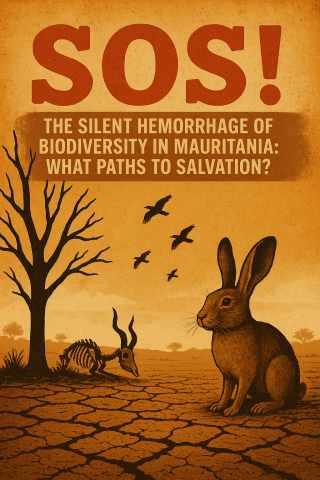
Just a few hours ago, our country celebrated "National Tree Day." This is an activity we must tirelessly sustain, both practically and intellectually. In this spirit, I am relaunching this SOS—a cry of ecological anguish that has haunted me for quite some time and which I am trying to make heard. Please share it.
Since the mid-20th century, Mauritania has lost a significant portion of its plant wealth and wildlife. However, precise data on extinct species are sorely lacking. Such information is absent from both official national archives and the databases of specialized international organizations, such as the International Union for Conservation of Nature (IUCN), which highlights a severe lack of environmental data, particularly on plant species. Regarding fauna, although various sources report the extinction of several species (elephants, lions, oryx, ostriches, etc.), reliable data remain scarce.
Yet, these sparse sources converge and align with the lived experiences and sentiments of anyone in Mauritania with environmental sensitivity: biodiversity is in danger. Recurrent droughts, desertification, rising temperatures, excessive hunting (terrestrial and marine), habitat loss, overgrazing, increasing urbanization, and multifaceted pollution (terrestrial, atmospheric, and marine) combine to exert massive pressure on fauna and flora, casting a bleak future. Despite this, hope persists, even if the reasons to believe struggle to break through.
We are deeply implicated, whether we like it or not.
The issue of threats and risks to wildlife and plant heritage is now a global challenge, topping the priorities of states and international organizations, mobilizing numerous specialized bodies. In Mauritania, we are not alone in facing this problem, which exceeds our own capacities, though we play a role—beneficial or harmful—depending on our actions.
We significantly contribute to the harmful environmental factors mentioned above, except for our share of global greenhouse gas (GHG) emissions, which accounts for only 0.015% of the total. Yet, our climate vulnerability is among the highest in the world: we rank among the 14 countries most exposed to the damages and constraints of climate change.
Anthropogenic GHGs are the primary cause of the climate disruption we observe today and the resulting damages to humanity. Addressing this rests on two pillars: mitigation and adaptation. Regarding these, Mauritania frequently expresses its vision to reduce its own GHG emissions while emphasizing prevention and resilience strategies to limit the harmful impacts of climate change, despite its minimal contribution to its causes. However, as a transboundary phenomenon, any change in its pace inevitably affects us, to varying degrees, depending on its scale and trajectories, which specialized bodies attempt to anticipate.
Focus on Two Scenarios…
To address our extreme climate vulnerability and promote ecological culture and knowledge, two types of scenarios are worth highlighting: the RCP (Representative Concentration Pathways) and the SSP (Shared Socioeconomic Pathways). Developed by the IPCC (Intergovernmental Panel on Climate Change) in collaboration with scientific consortia, these scenarios differ and complement each other, as they are used in climate models to guide researchers and policymakers in planning climate and sustainable development policies.
We will address them in two separate articles, starting with the RCP in this piece. RCPs are forward-looking climate evolution models that guide scientific research, recommendations, and policies to reduce GHG emissions and adapt to climate changes. They include four main scenarios with varying levels of ambition and feasibility: RCP 8.5, RCP 6.0, RCP 4.5, and RCP 2.6. We will focus on two: RCP 6.0 and RCP 2.6, highlighting their relevance to Mauritania’s specific needs.
RCP 6.0 Scenario
This scenario is not the worst of the four but remains alarming. Emissions continue to rise, leading to a global temperature increase of about 3 to 3.7°C by 2100, according to sources. For Mauritania, this would translate into prolonged droughts, extreme temperatures, accelerated desert advance southward and eastward, and the collapse of pastoral zones. These phenomena would have dramatic consequences for biodiversity, severely impacting pastoral and agricultural communities reliant on ecosystems for their livelihoods. Some sources suggest this scenario could lead to a loss of over 50% of animal diversity in much of the country due to factors such as:
- Loss of natural habitats for most mammals and reptiles.
- A significant decline in pollinating insect diversity, affecting birds and small carnivores.
- Likely extinction of endemic or rare species unable to migrate to wetter areas.
RCP 2.6 Scenario
This optimistic scenario envisions a significant reduction in GHG emissions, limiting global temperature rise to about 1.5 to 2°C by 2100. In Mauritania, this could lead to:
- More frequent or better-distributed rainfall, particularly in the southwest (Senegal River basin, Trarza, Brakna).
- Notable partial restoration of savannas and wetlands, enabling the return of certain natural habitats.
- Rehabilitation of aquatic ecosystems (Senegal River, Diawling Delta), revitalizing associated fauna: fish, amphibians, migratory birds.
- Increased plant productivity, strengthening the food chain: more insects and rodents, accompanied by more predators, ensuring a balanced natural ecosystem.
In this scenario, positive impacts could result in over 30% increase in animal diversity in certain regions. Alongside other expected positive outcomes, this should inspire hope among local populations and citizens in general. However, achieving these projections depends on factors beyond our control. As analyses show, the anticipated positive outcomes hinge on a significant reduction in GHG emissions in line with the Paris Agreement’s 2015 targets (1.5 to 2°C). Current policy data suggest humanity is not on track to achieve this.
Mauritania, unfortunately, lacks sufficient influence to alter this trajectory, as no single country can. This may temper hopes for this scenario. Nevertheless, we must cling to it and do everything to maximize its potential benefits, however unlikely they may seem.
Recommendations:
- Pursue a dynamic foreign policy at regional and international levels:
- Activate and effectively use climate diplomacy tools.
- Contribute to establishing international climate justice based on the “polluter pays” principle.
- Develop strategies to access international funding: Green Climate Fund (GCF), Global Environment Facility (GEF), World Bank, JET-P initiatives, etc.
- Focus on developing eco-citizenship:
- Promote a culture and knowledge fostering environmentally friendly, vigilant, and productive behaviors.
- Raise awareness among local communities about ecological issues while involving them in sustainable, resilient, and environmentally respectful development projects.
- Encourage and support agroecology and ecotourism.
- Strengthen adaptation and resilience capacities:
- Prioritize sustainable management of water infrastructure (dams, efficient irrigation: drip systems).
- Further harness renewable energies (solar, wind) to reduce fossil fuel dependency and attract investments.
- Conduct campaigns—engaging the population—in reforestation, afforestation, and desertification control: tree-planting projects with drought-resistant local species like acacia, complementing the “Great Green Wall” project.
- Produce and properly utilize updated biodiversity databases:
- Create a conducive human, material, and institutional environment for proper biodiversity data management.
- Continuously acquire and update data using modern technologies: satellite remote sensing, drones, GPS collars to track animal populations/individuals (migratory birds, endangered species, etc.).
- Establish scientific partnerships with organizations or institutions specialized in biodiversity studies and protection (universities, international organizations, foundations).
- Expand the mandate of ONEL (National Observatory for Environment and Coastline) to explicitly include wildlife and flora, or create a dedicated national biodiversity observatory to address these aspects.
These suggestions and the analyses supporting them aim to provide information to address a major dual national challenge: the dramatic erosion of biodiversity and the glaring lack of data on it. These are not verified or proven solutions but rather a cry of alarm. Let us hope it reaches receptive ears, knowing it is not the only message of this kind. National authorities responsible for this area are already doing much, and many non-governmental actors are also invested. However, the path is long, winding, and fraught with obstacles. It is, nonetheless, the only path worth taking, and it calls to us all: let us arm ourselves with eco-citizenship and take it, each at our own pace.
Colonel (Ret.) El Boukhary Mohamed Mouemel
References:
[i] http://mauriactu.info/ar/articles/7458
[ii] See notably: Updated Nationally Determined Contribution (NDC 2021-2023) and the “Fourth National Communication Report on Climate Change.”
[iii] Intergovernmental Panel on Climate Change (IPCC)
[iv] Representative Concentration Pathways
[v] Shared Socioeconomic Pathways, comprising five scenarios: SSP1, SSP2, SSP3, SSP4, and SSP5
category: