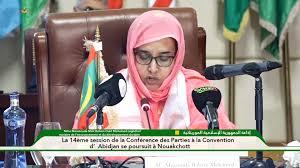
She is working hard to shake things up—and rightly so. Breaking the inertia that dominates our country’s environmental policy—if not outright “eco-apathy”—requires confronting tough obstacles and constraints, beginning with the well-known mauritanian proverb: “One hand alone cannot clap.” Governmental solidarity is therefore more necessary here than in any other domain.
The meeting with the Minister: a catalyst for citizen proposals...
Yes, the effectiveness of the “Environment and Sustainable Development” sector requires active synergy of governmental efforts. But the issue goes beyond coherence at the highest political levels or cooperation among various public administrations. Beyond aligning all these levels and stakeholders, we must first and foremost activate and cultivate a spirit of ecological citizenship (eco-citizenship).
From the very beginning of our exchange, I felt that my interlocutor, Her Excellency the Minister, Mrs. Massouda Baham Mohamed Laghdaf, was very receptive when I insisted on this concept. I appreciated her active listening and thought to myself: “Perhaps she is pleased that a passionate citizen, despite his advanced age, is deeply interested in something she holds dear.” A fleeting remark that crossed my mind.
I realized that the Minister and I were on the same wavelength regarding this topic: we converged on how to implement the concept through the development of multifaceted behaviors whereby individuals adopt eco-responsible actions based on, on one hand, respect and value for their environment and natural resources, and, on the other, continuous access to ecological information, its dissemination and enrichment, thereby contributing to building a citizen-driven force of proposals that can generate added ecological value.
With this in mind, I wanted to share with readers the insights and reflections that have gradually taken shape in my thoughts and were given a strong push by my meeting with Mrs. Massouda Baham Mohamed Laghdaf. I will summarize them in two points. The Minister may not fully share my view, especially on the second point, which we did not discuss during our meeting.
1. Eco-Citizenship
For nearly half a century, we have spoken of “global security” or “human security”—that is, all the elements necessary for human life to flourish, with top priority today being ways to address the accelerated effects of climate change and environmental degradation, both seen as key structural threats to human security.
Despite growing awareness of these dangers, the level of consciousness required to translate concern into protective policies and actions for future generations has yet to be achieved. This persistent shortfall—if not a permanent incapacity—reveals serious gaps in understanding environmental challenges. These are primarily due to widespread eco-ignorance, particularly in our country and other developing nations. Hence the need to build and foster fruitful ecological behavior, both individual and collective: this is the very essence of eco-citizenship.
There are many definitions of the concept, but we will retain the core idea: eco-citizenship is expressed through concrete actions by the “eco-citizen” or “green citizen”: sorting waste, saving energy, protecting nature, consuming responsibly, staying informed about the environment and spreading knowledge, raising awareness in one’s surroundings, and contributing to changing mentalities and behaviors on both individual and collective scales.
For such behavior to take root and grow, the overall environment—at national and local levels, and across political, social, and cultural domains—must participate in the educational process. Eco-citizenship therefore requires a significant educational effort by Mauritania. A major challenge the country must rise to. While the term “eco-citizenship” does not explicitly appear in the official literature of the Mauritanian Ministry, it is clearly embedded in its approach.
Indeed, on the Ministry’s Arabic-language website, under the sections “Environmental Themes” and “Environmental Education,” one reads:
“Since knowledge is the key to citizenship and responsible behavior, the goal is to implement public environmental education and awareness programs, and to strengthen technical and institutional capacities at all levels so they meet the requirements of good environmental governance. Emphasis will be placed particularly on youth and on topics such as pollution risks, the challenge of climate change, local community awareness, the promotion of a citizen culture, and the integration of environmental education into school curricula.” [i]
But the Ministry must be given the necessary means to fully fulfill this noble educational mission by mobilizing all actors (other government departments, private sector, civil society, families…), because environmental challenges concern everyone, due to the multidimensional nature of the methods and approaches needed to address them.
These holistic approaches involve the concept of mainstreaming, also called “integration” or “cross-cutting integration.” It means shifting from treating the environment as a peripheral issue to viewing it as a foundation for all policies: making environmental protection a cross-cutting element in all public and private decisions, moving from isolated projects to an integrated and coherent approach. It is a process of "embedding environmental considerations into all policies, strategies, programs, and practices of a sector, organization, or society, rather than treating them as a separate issue." The goal is to make environmental protection and sustainable development “a central and systematic component of decision-making processes at all levels (political, economic, social, etc.).”
Such a global approach requires Mauritania to strengthen and elevate its Ministry of Environment and Sustainable Development in order to implement it effectively.
2. Enhancing the Ministry
By “valorization,” we mean raising the institutional and political weight of the Ministry of Environment and Sustainable Development—whether by expanding its prerogatives, increasing its budget, or transforming it into a Ministry of state with greater political stature within the government and on the international stage. Given the importance of both internal and external institutional and political weight, we favor the latter option.
Such a promotion would yield multiple internal and external benefits. On the protocol level, the ministry would hold a higher rank, giving its head easier access to the President and Prime Minister. He or she would thus be better positioned to influence strategic environmental decisions, especially within interministerial committees. Their voice would carry more weight in budget allocations and project evaluations with direct environmental impact: mining, energy, livestock, agriculture, processing industries, etc. There would also be positive impacts on Mauritania’s fulfillment of its international commitments, such as its Nationally Determined Contribution (NDC 2021–2030) and future contributions under the Paris Agreement.
Externally, the benefits would be both diplomatic and financial.
Mauritania would speak with a stronger voice in major international forums (COP, UN assemblies and conferences, G20, G7, and possibly in the future, the BRICS), as well as in regional platforms (African Union, Arab League, OIC...).
Regionally, as a country at the crossroads of West Africa, the Maghreb, and the Sahel, Mauritania has a strategic geopolitical position. A State Ministry for the Environment could leverage this position to exert regional leadership on climate issues.
From a thematic perspective, this status would make it possible—aligned with the mainstreaming concept mentioned earlier—to integrate environmental priorities into bilateral and multilateral discussions, aligning climate goals with the country's economic and security priorities.
It would also send a strong signal to donors—especially if accompanied by dedicated mechanisms such as the creation of a climate finance unit to attract funding and the issuance of “green sukuk” to mobilize sovereign capital from the Gulf and the Middle East, in addition to international donors such as: the Green Climate Fund (GCF), the Global Environment Facility (GEF), the World Bank, and Just Energy Transition Partnership (JET-P) initiatives.
Conclusion
Effectively investing in the culture and development of eco-citizenship is a major imperative for Mauritania. It requires the Ministry of Environment and Sustainable Development to engage in all directions. Granting it the status of “State Ministry” would offer cross-sectoral capacities, enabling it to project its voice louder and farther—both domestically and internationally.
Colonel (ret.) El Boukary Mohamed Mouemel
[i] http://www.environnement.gov.mr/ar/index.php/pages/education-a-l-environ...
category: